13 Area Rug Ideas That Make a Small Room Feel Twice as Big

A small room rarely feels small because of its measurements. It feels small because your eye keeps stopping — at the edge of a tiny rug, at a dark patch of floor, at furniture floating in separate pieces. Every stop tells your brain the room is chopped up, and chopped up reads as cramped.
An area rug is the one change that removes most of those stops at once. The current advice is almost the opposite of instinct: instead of a small, dark rug placed safely in the middle, go bigger, lighter, flatter and simpler, and let the rug connect everything on top of it.
The 3 space rules behind every idea below:
- Size up, not down. A rug that reaches under the furniture makes one large zone; a small rug floating alone makes a postage stamp. Most small living rooms need a 6×9 or even an 8×10, not a 4×6.
- Keep the palette light and tonal. Warm creams, oatmeal and soft greige reflect light and blur the boundary between rug, floor and sofa — warm neutrals have replaced cool grey as the go-to palette.
- Fewer edges, even edges. One rug, one calm border of bare floor (about 8–18 inches), and a low, flat surface keeps the eye moving instead of counting lines.
1. Go a Size Bigger Than Feels Safe
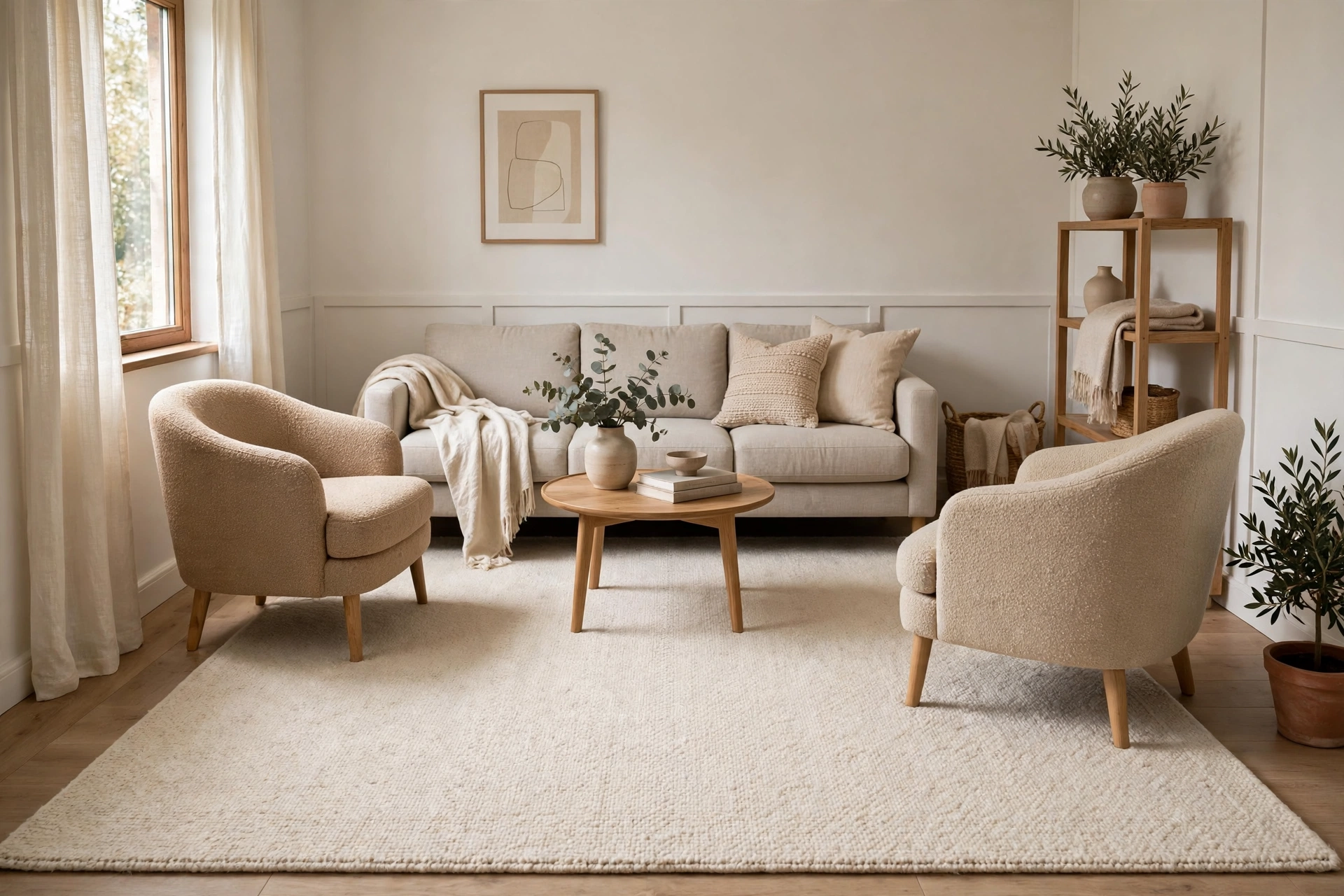
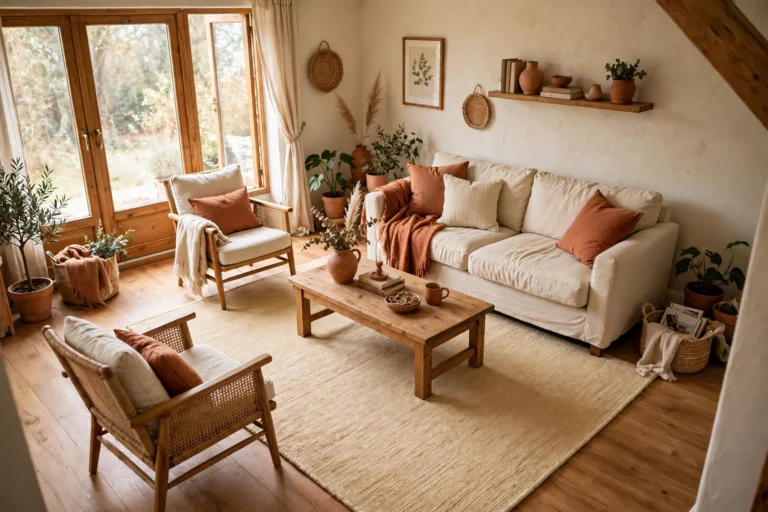
This is the counterintuitive move everything else builds on: a bigger rug creates one continuous, calm floor plane, so the eye reads the seating area as one generous zone, not small pieces squeezed together. Use the largest rug the room can handle, then pull it back just enough to leave a border. In a room around 10×12 feet a 6×9 usually works, and an 8×10 is often the sweet spot — and the rug should run a few inches past each end of the sofa, because a rug shorter than the sofa makes the seating look pinched.
Tip: Tape both size outlines on the floor and live with the larger one for a day — the “too big” outline is usually the one that makes the room relax.
2. Choose a Warm Light Color That Borrows Light
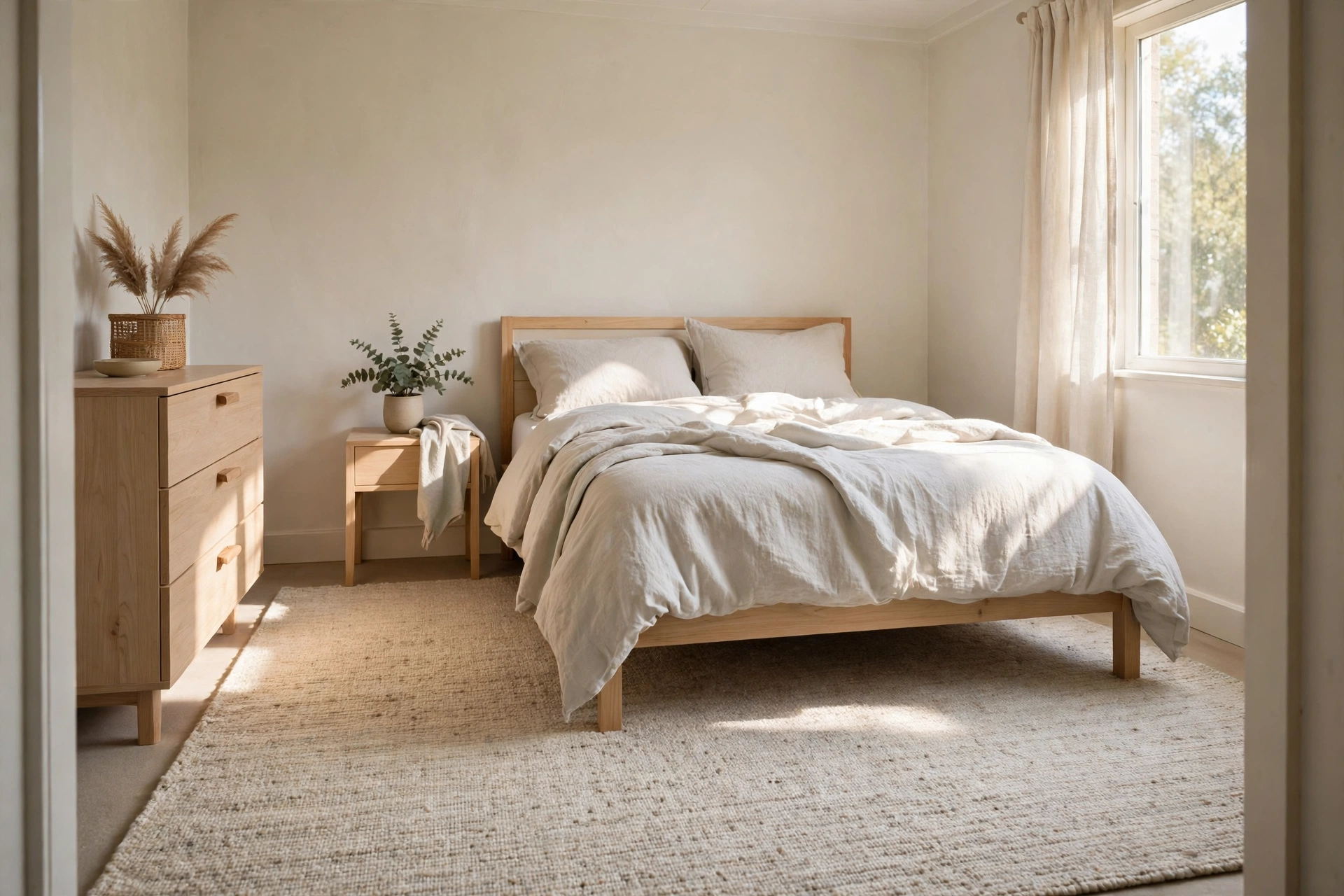
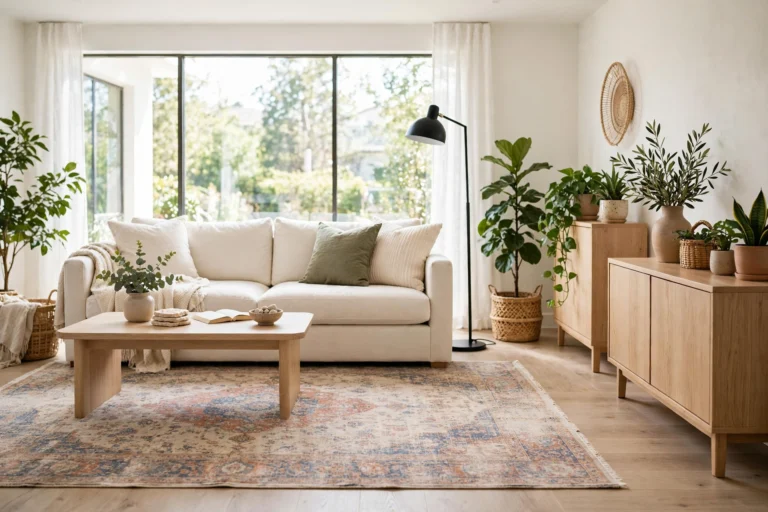
Light rugs do not just look airy — they reflect more light back into the room, including into the corners where small rooms go dark and feel closed in. The shades doing this best right now are warm ones — cream, ivory, oatmeal, sand, pale greige — the warm neutrals now dominant, replacing the cool greys that made small rooms feel flat. Keep the rug within a few shades of your floor: on warm wood, oatmeal keeps the whole floor reading as one light surface, while strong contrast draws a hard outline your eye cannot unsee.
Tip: Check a sample corner against your floor at the darkest time of day, not the brightest — a rug that still looks light at 6 p.m. will open the room up all day.
3. Run Stripes in the Direction You Want to Grow
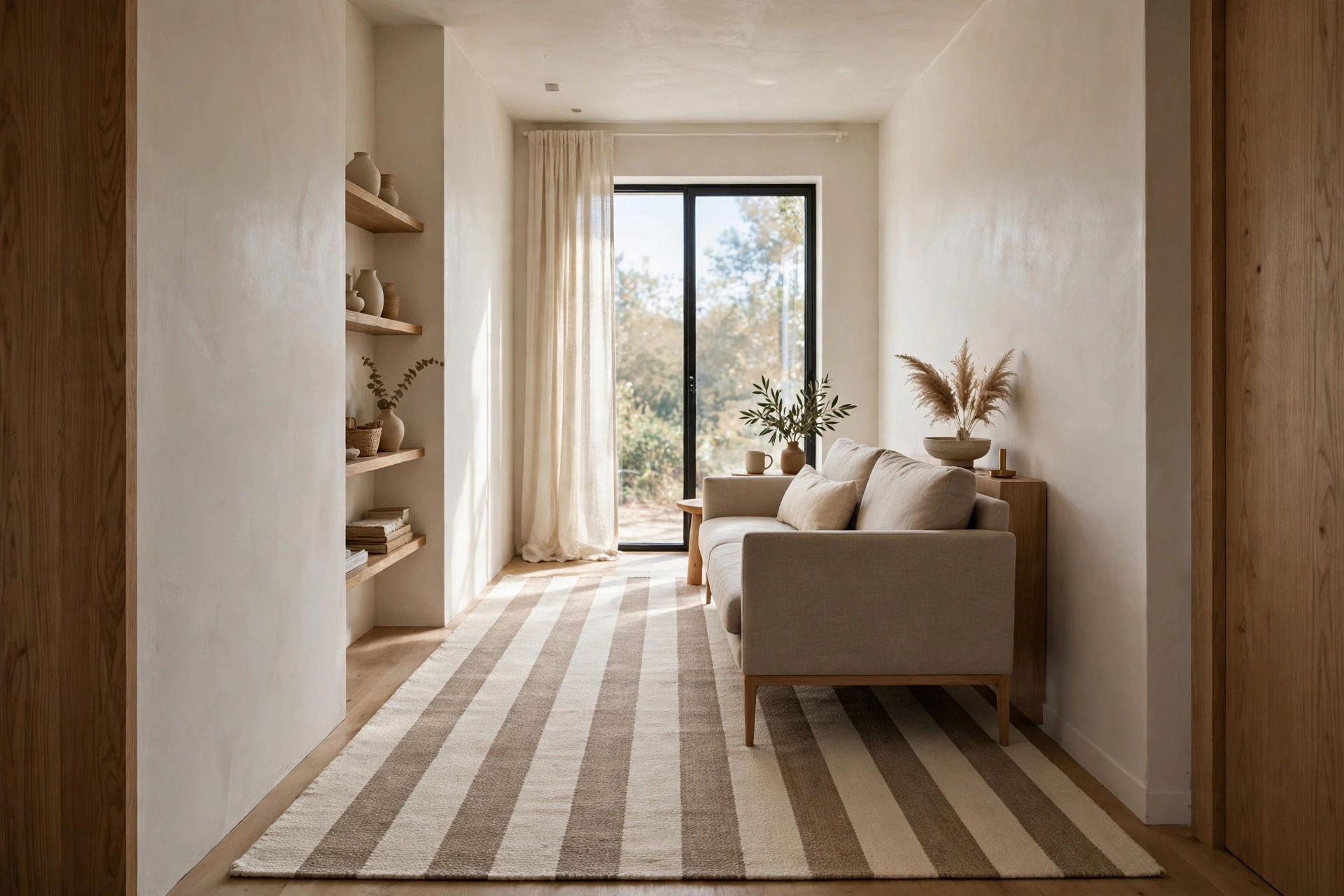
Stripes are the closest thing a rug has to an optical illusion: lines pull the eye along them, so a striped rug makes the room feel longer or wider depending on which way they run. Run the stripes lengthwise, toward the far wall, and a short room feels stretched; turn them across the short dimension — perpendicular to the long walls — and a narrow room feels wider. The version that works is quiet: wide, tone-on-tone stripes in two close shades like cream and soft taupe — the kilim flatweave look back in force right now. Thin, high-contrast pinstripes do the opposite — they vibrate visually and make the floor feel busy and smaller.
Tip: Lay a striped throw on the floor to test the direction first — the widening effect is obvious within seconds, and it costs nothing to check.
4. Pick a Faded Vintage Rug in a Washed, Low-Contrast Palette
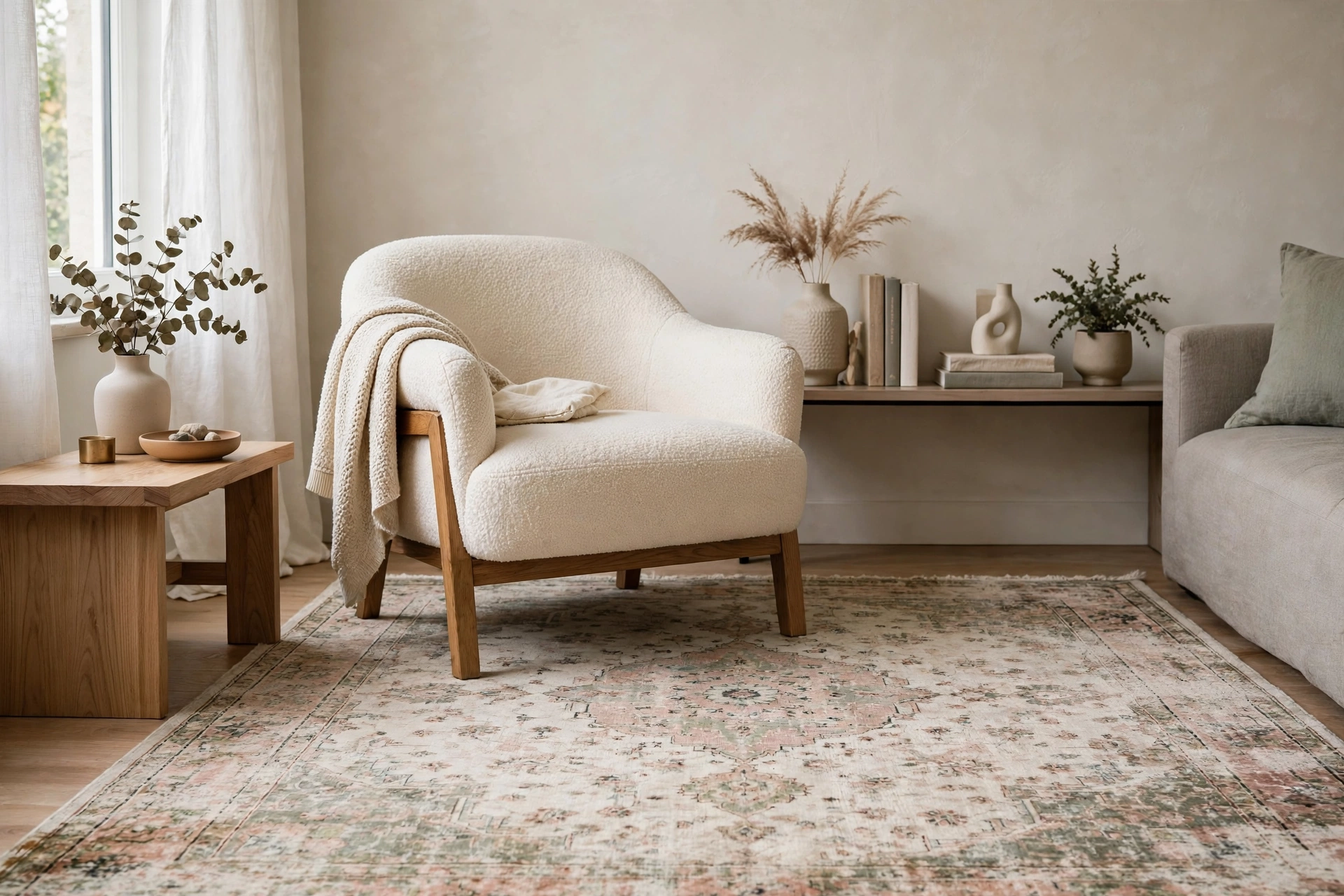
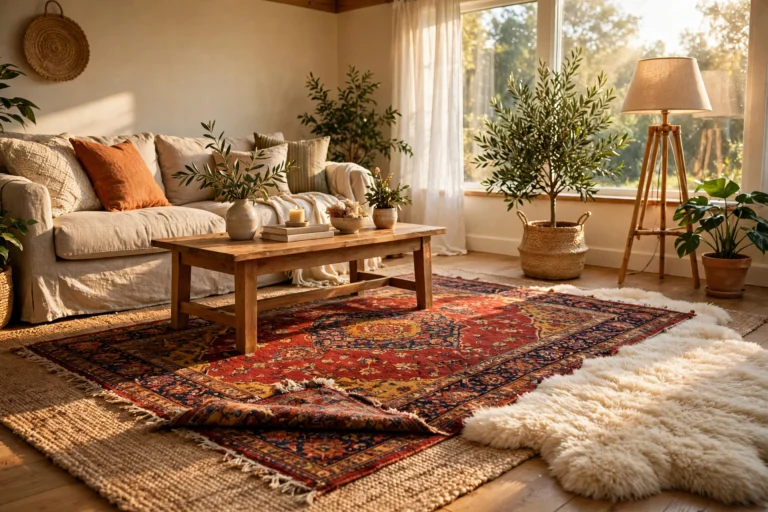
Vintage and Persian-style rugs are a strong trend right now, but the trending version is not the deep red, high-contrast antique look. It is the faded, sun-washed version — ivory, dusty blush, muted sage, soft blue-grey — with the pattern gently distressed so it reads as texture from across the room rather than a busy picture under your feet. That softness is what a small room needs: character without the visual weight of a dark rug, because low contrast blends the pattern into one light field — and a faded pattern hides dust and footprints far better than solid cream.
Tip: Look for “distressed,” “faded” or “antique wash” in the description — you want the pattern visible up close but almost disappearing from standing height.
5. Keep the Pattern Large-Scale and Tonal

Pattern scale matters more than pattern itself. Small, intricate motifs create hundreds of tiny visual stops, and a floor full of stops feels crowded; large-scale patterns — an oversized diamond, a broad check, a wide abstract sweep — put only a few calm shapes on the floor, so the room reads as open even though the rug is not plain. Keep it tonal, too: monochromatic pattern in deeper and lighter versions of the same color is a major current direction, adding interest through texture, not contrast. A cream-on-warm-white geometric in a high-low weave gives a small room depth without any dark color pulling the walls in.
Tip: Apply the squint test to product photos: if you squint and the pattern mostly melts into one light color, it will enlarge the room; if it stays busy, it will shrink it.
6. Go Low-Pile or Flatweave So the Floor Stays One Calm Plane
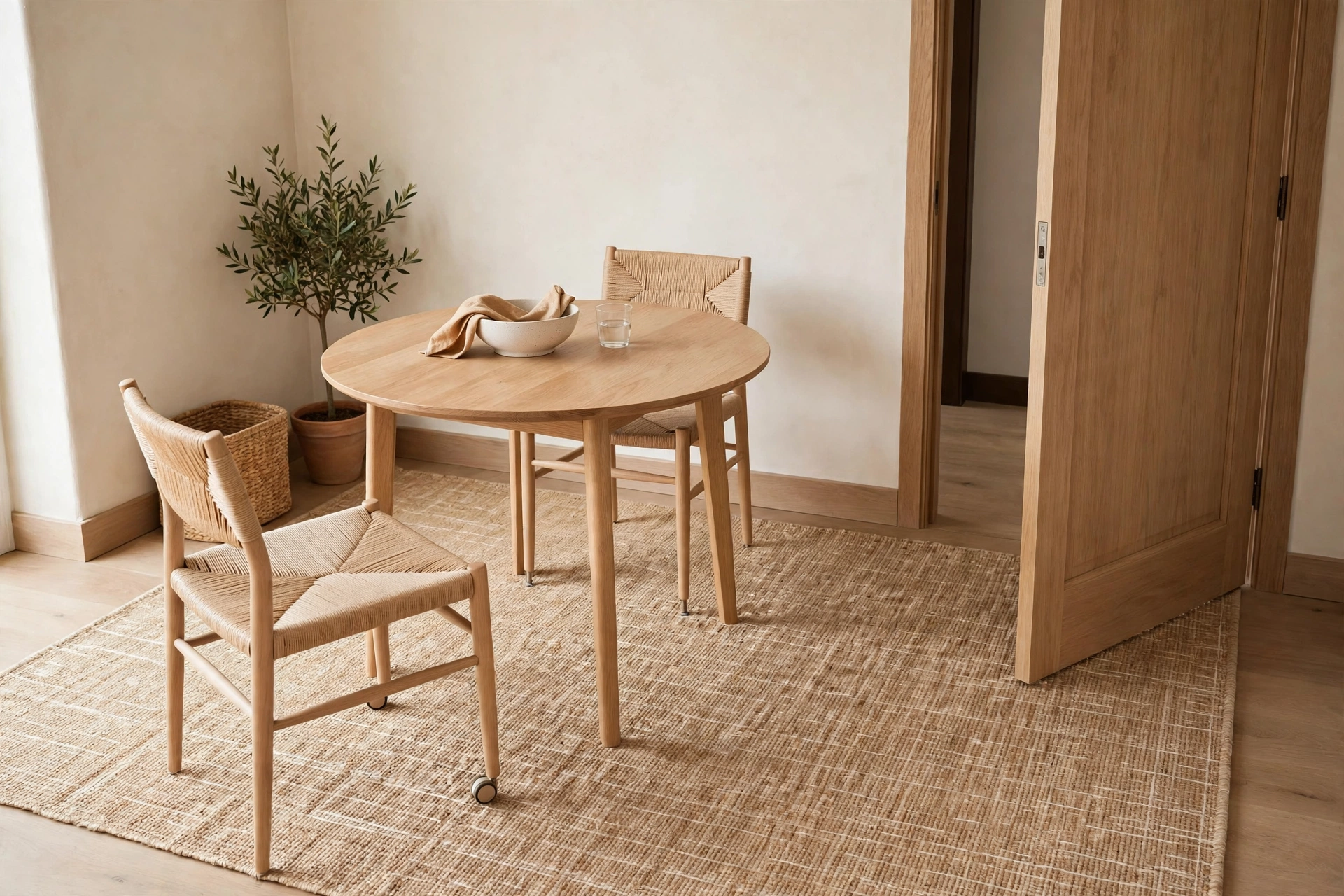
Thick pile feels luxurious in a showroom, but in a small room it adds visual bulk, swallows furniture legs, and makes the floor sit higher and busier — why designers steer small spaces away from heavy shag and deep tufting. A low-pile rug or true flatweave keeps the floor as one flat, quiet plane the eye glides across, and flatweaves are trending in their own right: kilim-style weaves, cotton dhurries and natural-fiber-look weaves in warm sand and oat tones. The practical bonuses suit small homes too — doors swing over them, chairs slide instead of snagging, and they roll up easily when storage is scarce.
Tip: Get softness from a felt rug pad underneath rather than pile height — cushion below, calm flat surface above.
7. Use a Bordered Rug as a Frame, Not a Fence
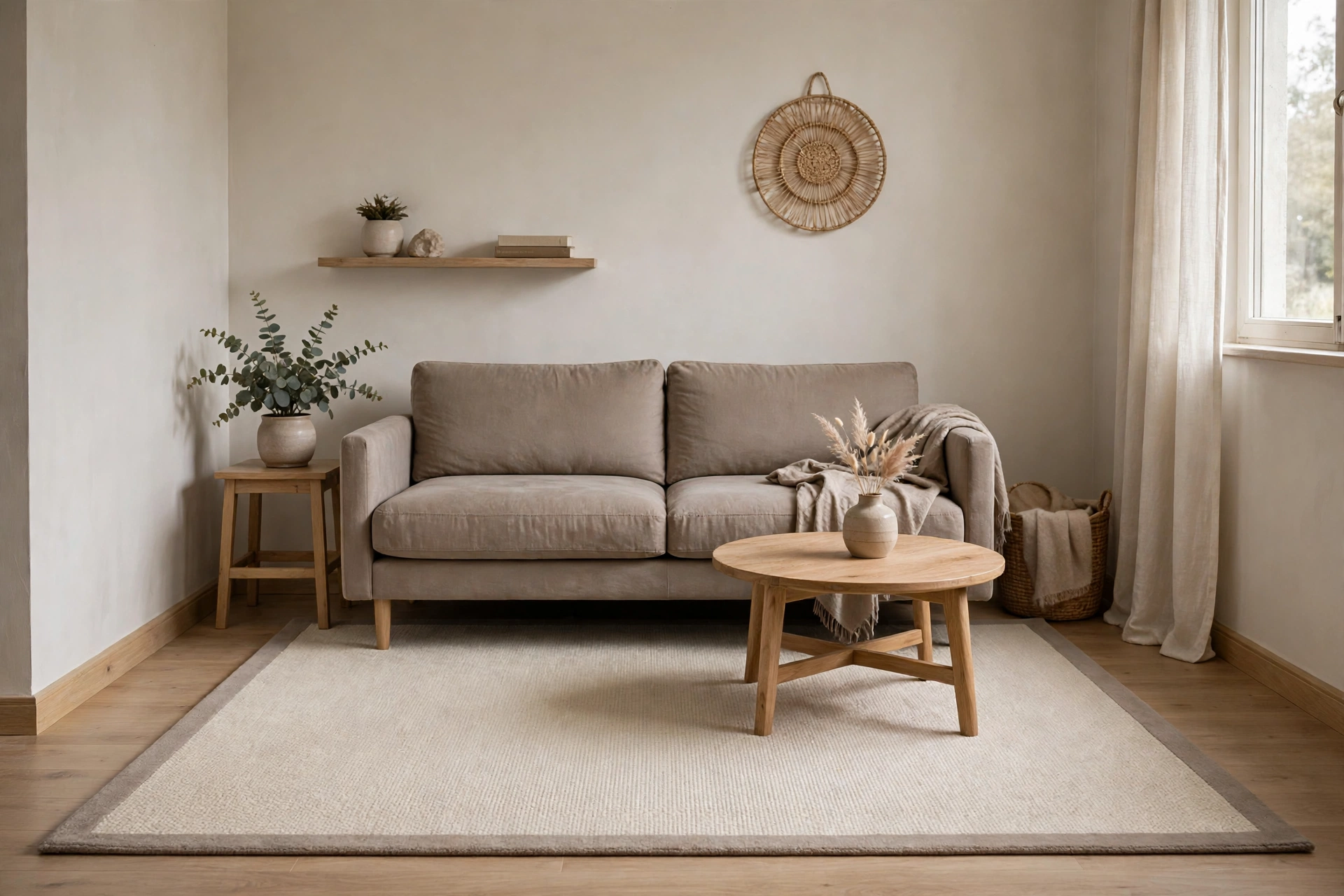
A single border woven into a rug works like the frame around a picture: it tells the eye where the seating area begins and ends, and a defined area reads as deliberate and organized — two qualities that make any room feel bigger than a scattered one. The small-room rules are contrast and count: keep the border tonal — a soft taupe line on ivory, a deeper sand on cream — rather than a hard black or navy edge, which fences the area in and measures it, and choose one simple border, not three nested ones, because each extra line is another stop for the eye.
Tip: Match the rug’s border with an even margin of bare floor outside it — about 8–12 inches in a tight room — so there are two calm frames, not a border colliding with a wall.
8. Match the Rug Closely to Your Floor and Sofa
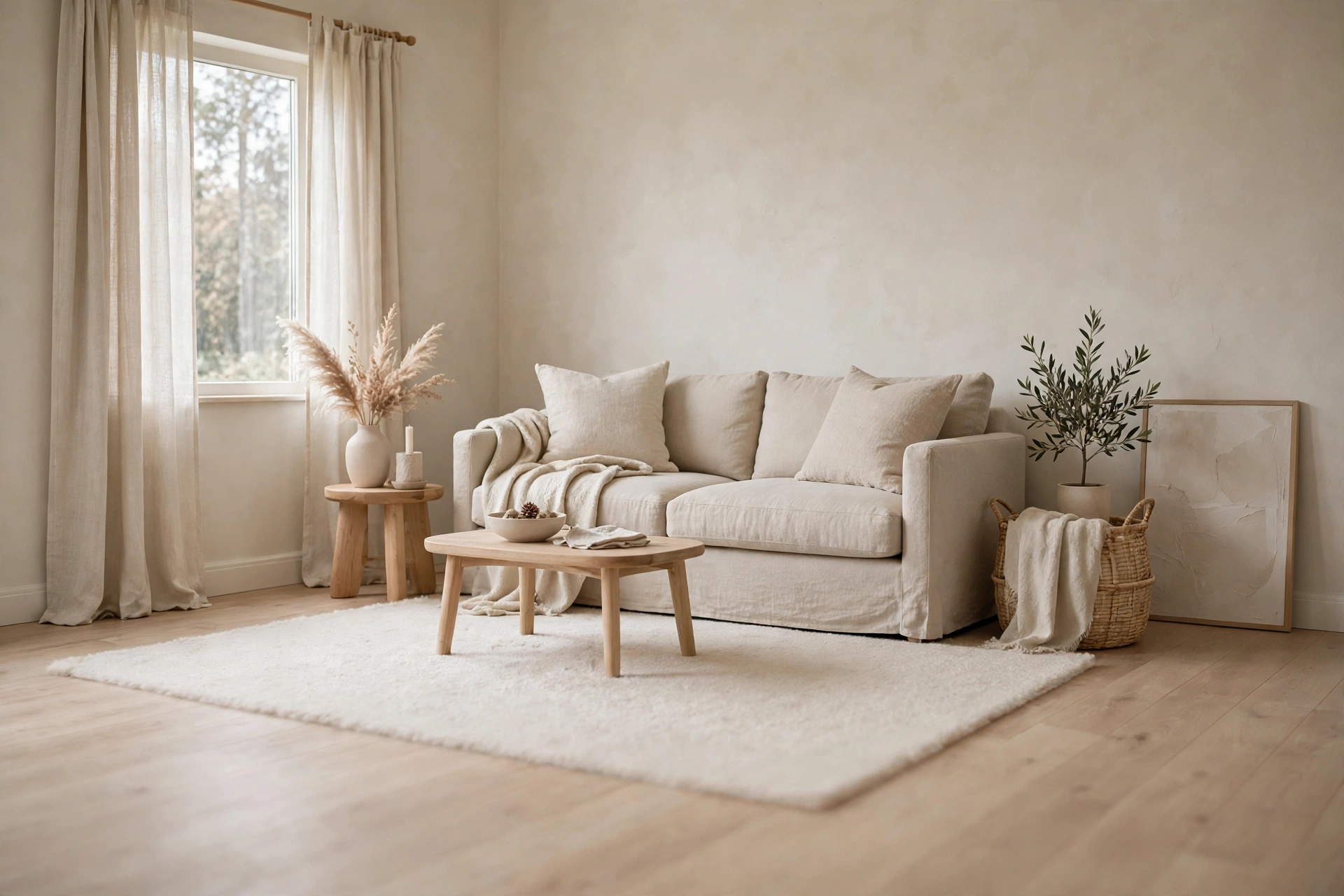
Every strong line where one surface ends and another begins is information about size. When your rug is close in color to both the floor beneath it and the sofa on top of it, those lines soften or disappear, and the room stops announcing its dimensions — the tone-on-tone, monochromatic approach behind the quiet-luxury direction interiors have been moving in, with warm whites, creams and oatmeals layered in texture instead of contrast. Do not aim for an exact match: pale oak floor, warm white heathered rug, oatmeal linen sofa, one shade lighter or deeper as you layer, textures varied so the room feels layered, not flat.
Tip: Photograph your room and view it in black and white. If the rug shows as roughly the same grey value as the floor and sofa, the tones are close enough to blur the boundaries.
9. Try a Round Rug to Soften a Boxy Room
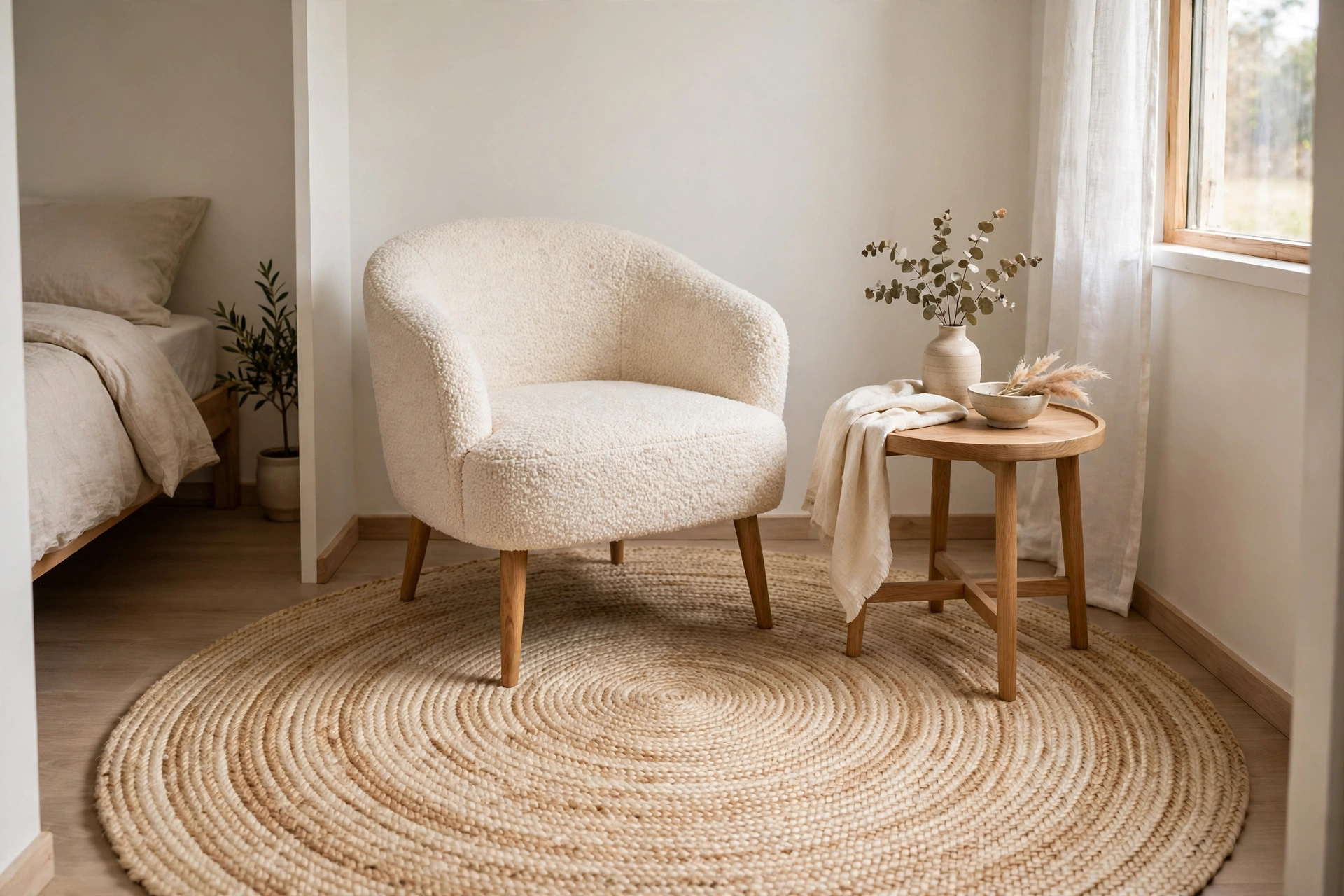
Small rooms are boxes of straight lines and right angles, and a rectangular rug adds one more set of corners, emphasizing the box. A round rug removes them: with no corners of its own it does not line up against the walls to be measured, and the floor left visible in the room’s corners makes the footprint feel less pinched. Round works best where furniture is grouped — under a reading chair and side table, beside a bed, or under a round dining table — and the diameter should reach under the chair’s front or the bed’s edge, so the circle anchors something instead of floating.
Tip: Center the round rug on the furniture grouping, not the room — an off-center circle looks like a mistake, while a furniture-centered one looks like a design choice.
10. Let an Organic, Wavy Shape Break Up the Grid
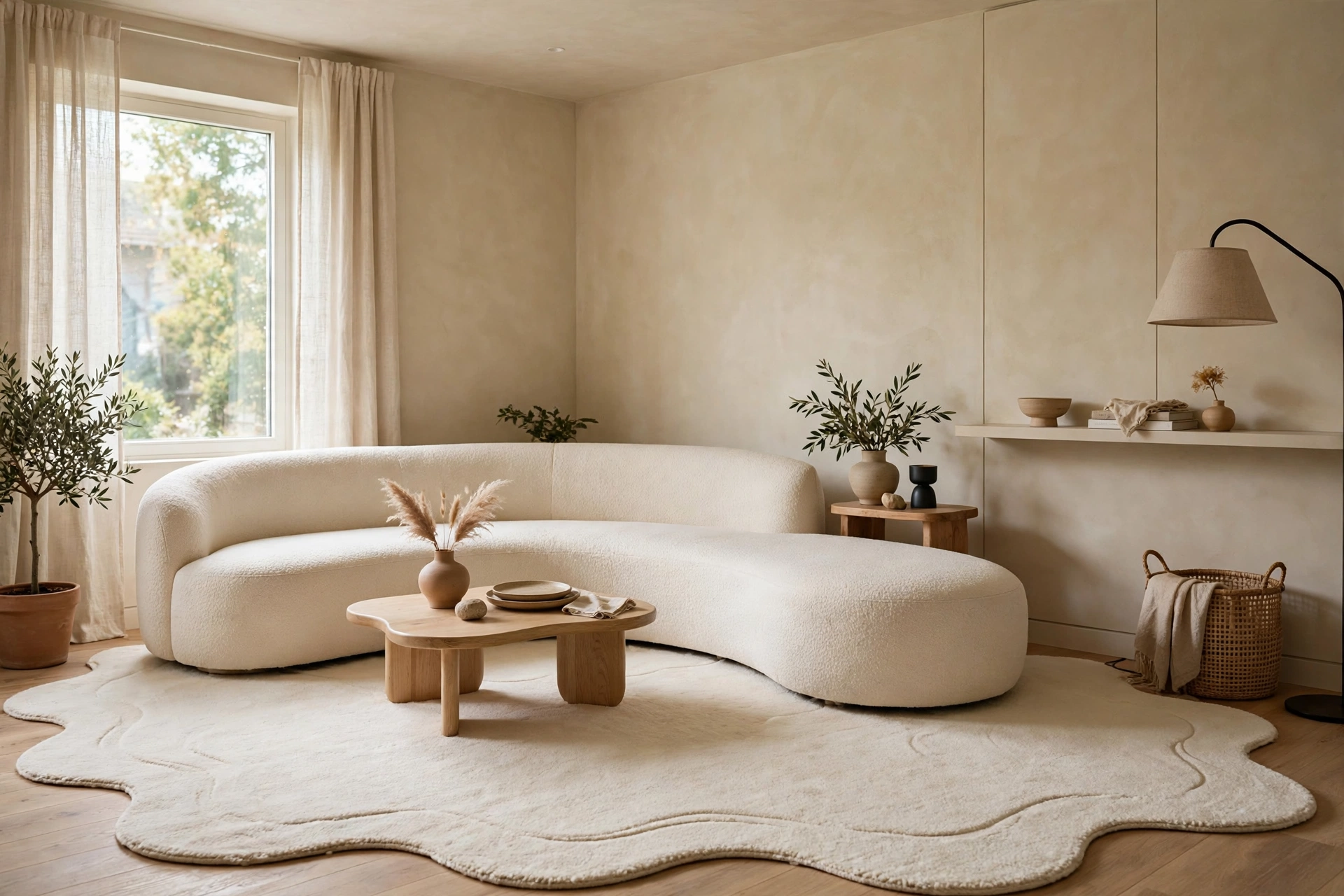
Organic, curvy, asymmetrical silhouettes are a headline rug trend right now, designed to flow through a room instead of fitting it like a tile. In a small room that irregular edge is genuinely useful: the eye cannot measure a wavy outline against a straight wall, so one more piece of size information disappears. An organic rug also solves awkward geometry — slipping under a sofa, curving around a radiator, leaving a walkway open without looking cut off. Keep the color light and the surface low and tonal: in a wavy shape the silhouette is the statement, and a busy pattern on an irregular outline is more noise than a small room can carry.
Tip: Organic rugs photograph bigger than they measure — tape the longest and widest points on your floor before ordering, since the usable area under furniture is smaller than the headline size.
11. Layer Two Rugs in One Palette for Depth Without Chop

Layering sounds like it would crowd a small room, but done in one palette it does the opposite: the big base rug enlarges, and the smaller top rug adds pattern and softness. The trending base is an oversized natural-fiber rug — jute, sisal or a woven-look flatweave in a warm natural tone — run as large as the room allows, with a smaller cream or faded vintage-style rug centered over the seating. Two rules keep it expansive: both rugs stay in the same warm, light family, so their boundary is a texture change, not a color change; and both layers stay flat, so the step between them is barely there.
Tip: Make the top rug about two-thirds the base size, centered on the coffee table or bed — an even frame of jute on all sides makes it look planned.
12. Anchor With the Front Legs Only — and Show Floor Behind

How the furniture meets the rug decides whether the room feels connected or scattered. The layout designers rely on most in small rooms is front legs on: the front legs of the sofa and every chair sit a few inches onto the rug — roughly 3–6 inches — while the back legs stay on bare floor, so the seating reads as one anchored group but the floor visible behind and around it keeps the room feeling open. Details matter: the rug must extend past each end of the sofa by about 6–8 inches, every seat must touch it the same way, and it is centered on the seating group, not the room — if your sofa is shifted for a door swing, the rug follows the sofa.
Tip: Slide the rug under the sofa a little further than you think it needs — most front-legs layouts fail by stopping too short, leaving the rug floating toward the coffee table.
13. Replace the Scatter of Small Mats With One Washable Rug
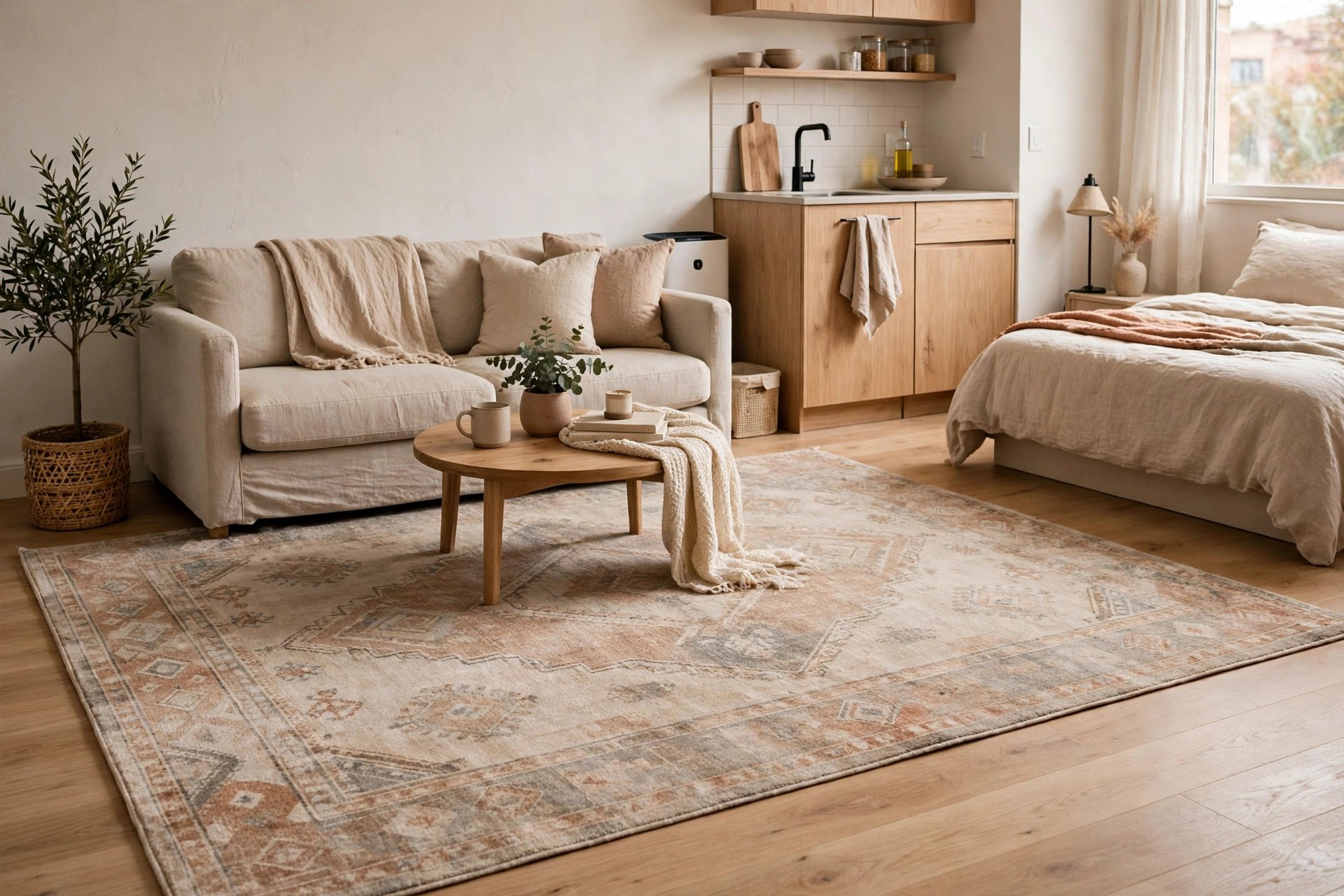
Many small rooms are dotted with several rugs — a mat by the sofa, a small one by the bed, a fragment near the door — each another island, another set of edges, another measurement. Replacing that scatter with a single large rug is often the fastest transformation on this list, especially in a studio, where one rug defines the living zone and lets the rest of the floor flow uninterrupted. Make it washable and it solves the practical side too: machine-washable rugs are the single biggest rug trend of the moment, driven by renters and pet owners, and they are made low-pile and flat — exactly the profile a small room wants.
Tip: Measure the floor your small rugs sit on — combined, they are usually smaller than one 6×9, so the single rug means more soft floor for similar money.
Before You Buy: 5 Small-Room Rules That Save Regret
- Tape it first — mark the outline with painter’s tape and check it against the sofa ends, door swing and walkways (paths of about 30–36 inches, fully on or fully off the rug). Living with the tape for a day prevents the most common mistake: ordering too small.
- Size to the furniture, not the room’s name — a living room rug should reach at least the front legs of every seat and run past the sofa ends; under a bed it should extend well beyond the sides and foot. If budget only stretches to a 4×6, layer it over a larger flat base instead of floating it alone.
- Keep the border even and modest — roughly 8–12 inches of bare floor in a tight room, up to 12–18 if you have it, as equal as you can manage on opposite sides. An uneven border makes even a big rug look lost.
- Check pile against doors and chairs — measure the gap under your doors and choose low-pile or flatweave if clearance is tight; confirm chairs can slide on it.
- Always use a thin rug pad — a slim felt or felt-and-rubber pad stops creeping and corner curl, protects the floor (deposit-friendly for renters), and restores lost cushion without a thick rug’s bulk.
Frequently Asked Questions
What size area rug is best for a small living room?
For most small living rooms, a 6×9 or 8×10 is the sweet spot. The real test is the furniture: it should sit under at least the front legs of the sofa and chairs and extend past each end of the sofa. A 5×8 can work under a compact loveseat, but a 4×6 almost always reads as a doormat.
Do light-colored rugs really make a room look bigger — and will they show dirt?
Yes — light colors reflect light into corners and blur the rug-floor line, which is why warm creams and oatmeals are the current default. For dirt, choose a heathered, tonal or faded vintage pattern over a flat solid, and a washable low-pile design for busy rooms.
Should all the furniture legs be on the rug in a small room?
All legs on gives the most unified look, but it usually demands a 9×12, which most small rooms cannot take. Front legs on gives nearly the same connected feeling at a 6×9 or 8×10, and is the layout most designers use in apartments. What never works is a mix — some pieces on, some completely off.
Can I use a patterned rug in a small room, or must it be plain?
Pattern is fine — it hides wear and adds character. Keep it large-scale and low-contrast: wide stripes, oversized geometrics, tonal weaves and faded vintage patterns all enlarge. What shrinks a room is small, busy, high-contrast pattern.
The Bottom Line
A small room does not need a small rug — it needs a rug that stops measuring the room out loud. Go bigger than instinct suggests, keep the color warm and light, keep the pile low, and let the furniture stand on the rug so everything reads as one generous zone. Faded vintage wash, tonal layers over jute, or one washable rug replacing a scatter of mats — the principle is the same: fewer edges, more floor, calmer eye. Tape the outline first, and let the rug do the enlarging for you.
Save this list for your next room refresh, and follow Decor Velora for 3 fresh home decor ideas every day — rugs, small apartment decor, mirrors, curtains and cozy room makeovers.