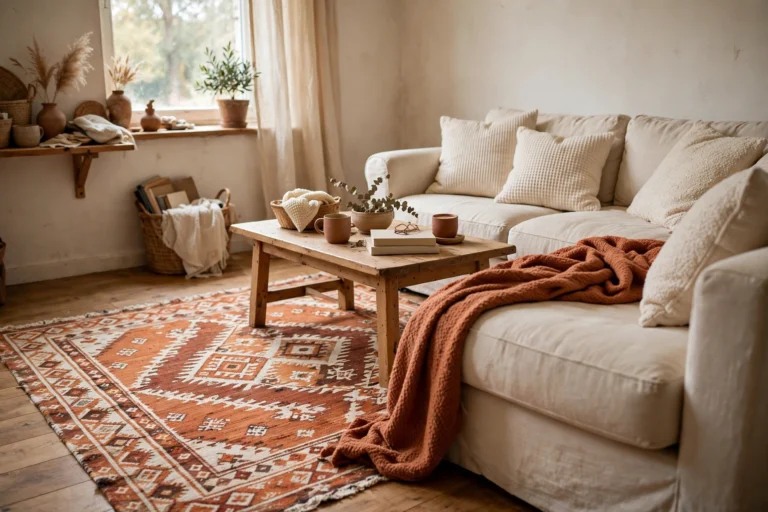
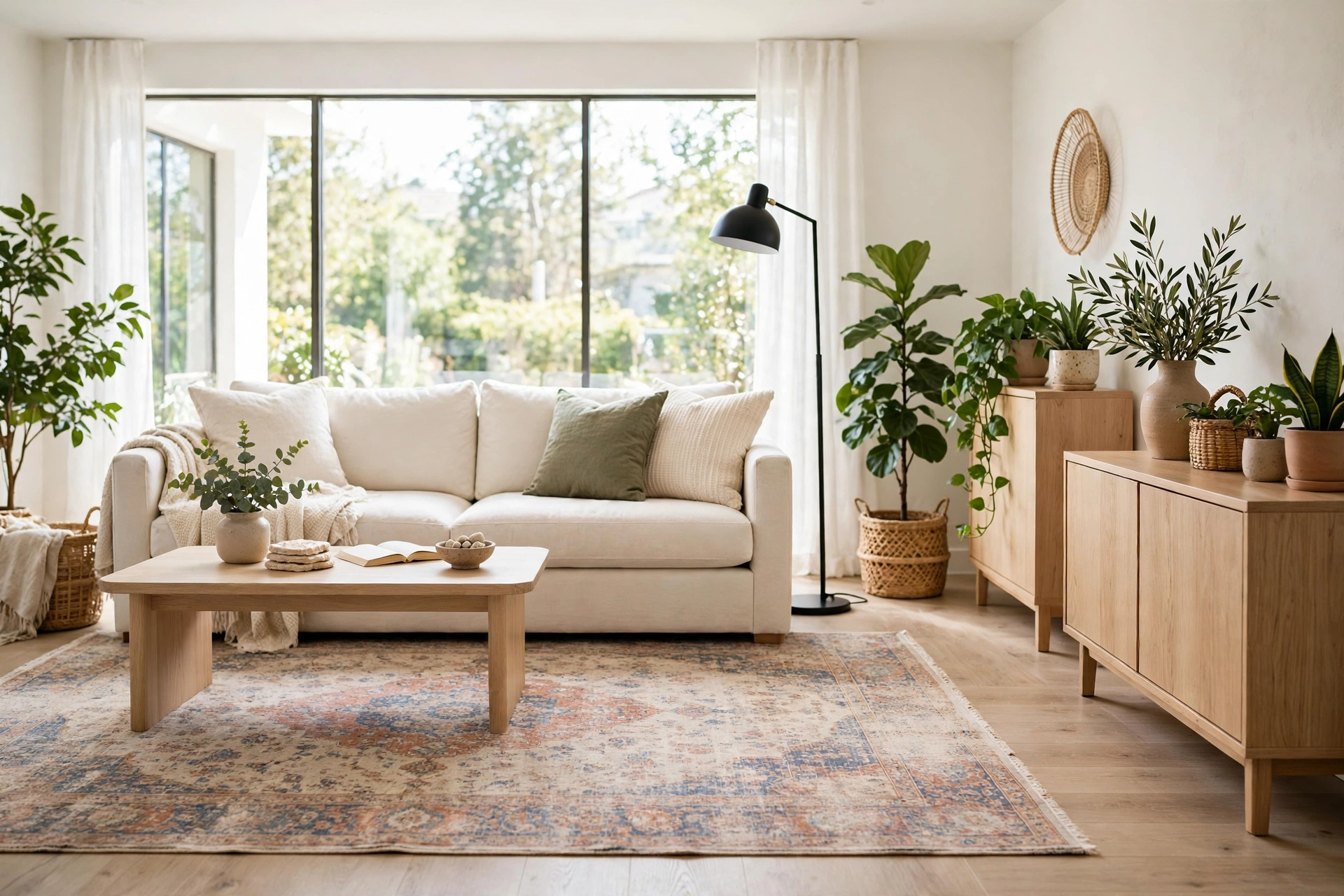
How to Style a Persian Rug Without Making Your Home Look Dated
A Persian rug is never what makes a home look dated. The styling around it is. The same rug that anchors a fresh, magazine-worthy room in one house can sit in another and make the whole place feel like a period set — and the difference is almost never the rug itself. It is the finish chosen, the furniture it is paired with, and a handful of habits, mostly inherited from how these rugs were styled decades ago.
The good news is that every one of those habits is easy to break. Modern Persian styling runs on contrast: the rug brings the age, everything else brings the present. Faded finishes instead of bright ones, clean lines instead of carved ones, echoes instead of matches. Follow the principles below and a Persian rug — antique, vintage-look or brand new — reads as the most confident, current piece in the room.
Work through them in order. The first two are about choosing and pairing the rug; the rest are about what the rest of the room should, and should not, do around it.
The 3 anti-dated rules behind every step below:
- Contrast is the whole strategy. Old rug, new room. The moment the furniture tries to match the rug’s era, the room becomes a theme; keep the eras in tension and it stays design.
- Soften the rug, sharpen the room. Faded rug finishes and crisp, simple surroundings is the modern formula — bright rug plus soft, traditional surroundings is the dated one.
- Nothing matches exactly. Colours are echoed at lower volume, never copied. Exact matches are what make a styled room look staged in the wrong decade.
Step 1: Choose a Faded or Distressed Finish, Not a Bright One
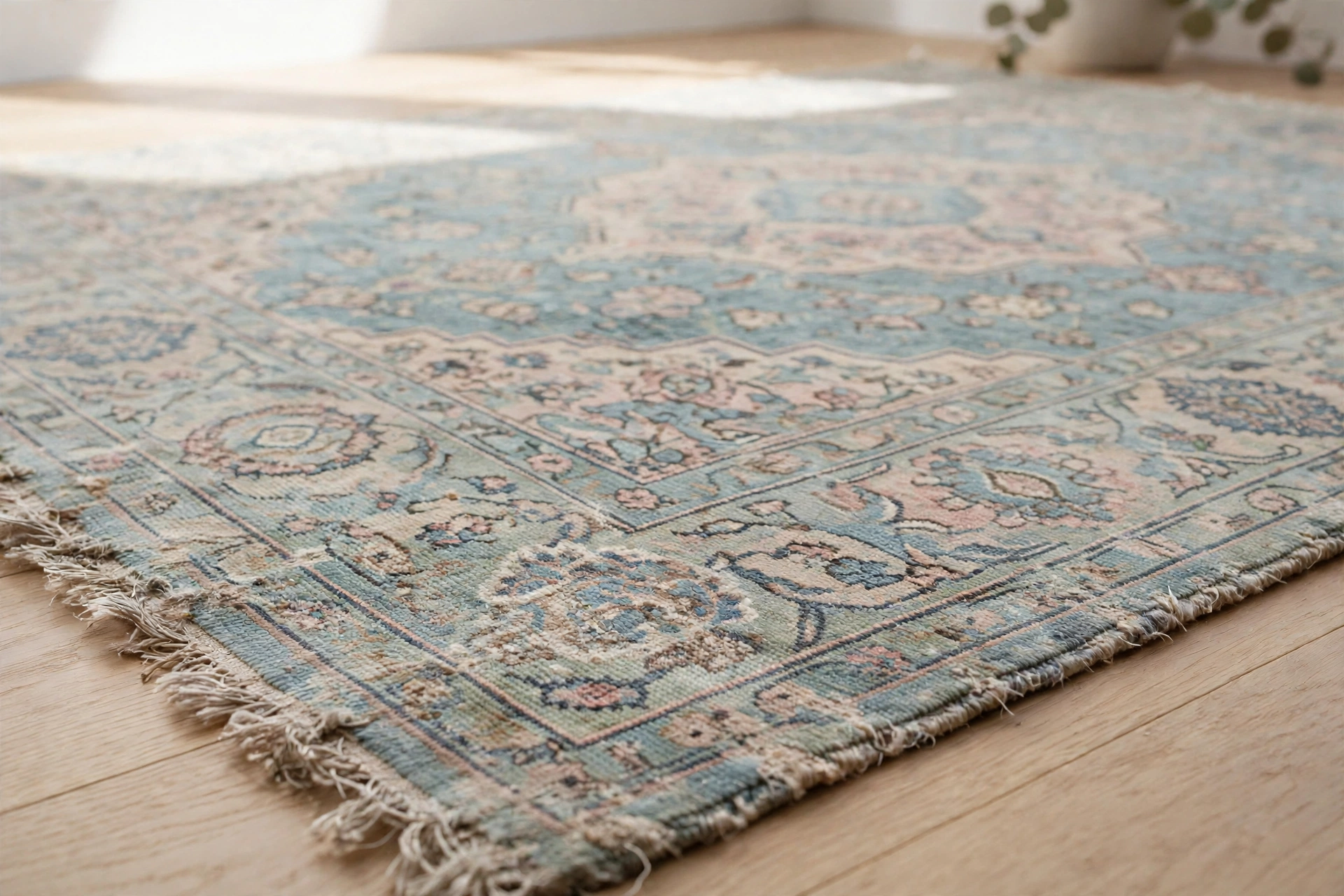
If you change only one thing, change the finish. The single biggest reason a Persian rug reads as dated is a bright, crisp, high-contrast pattern — the saturated scarlet, the sharp navy, the gleaming new-wool sheen of a rug trying to look freshly made. Design has moved decisively the other way: vintage-wash, distressed and faded finishes, where the colours arrive softened as if by decades of sunlight, are how the classic pattern speaks to a modern eye.
Faded does two jobs at once. Visually, it lowers the pattern’s volume so it can sit beside contemporary furniture without shouting. Practically, it hides wear, crumbs and fading of your own, since the rug already wears its age as a design feature. If you already own a bright Persian, you cannot re-fade it — but the steps below matter even more, because everything else in the room must do the softening for it.
Tip: When shopping, compare rugs in the faded section first even if you love colour. A washed burgundy delivers the same warmth as a bright red at half the risk — you can always add saturation back with a cushion.
Step 2: Pair It With Clean-Lined Modern Furniture
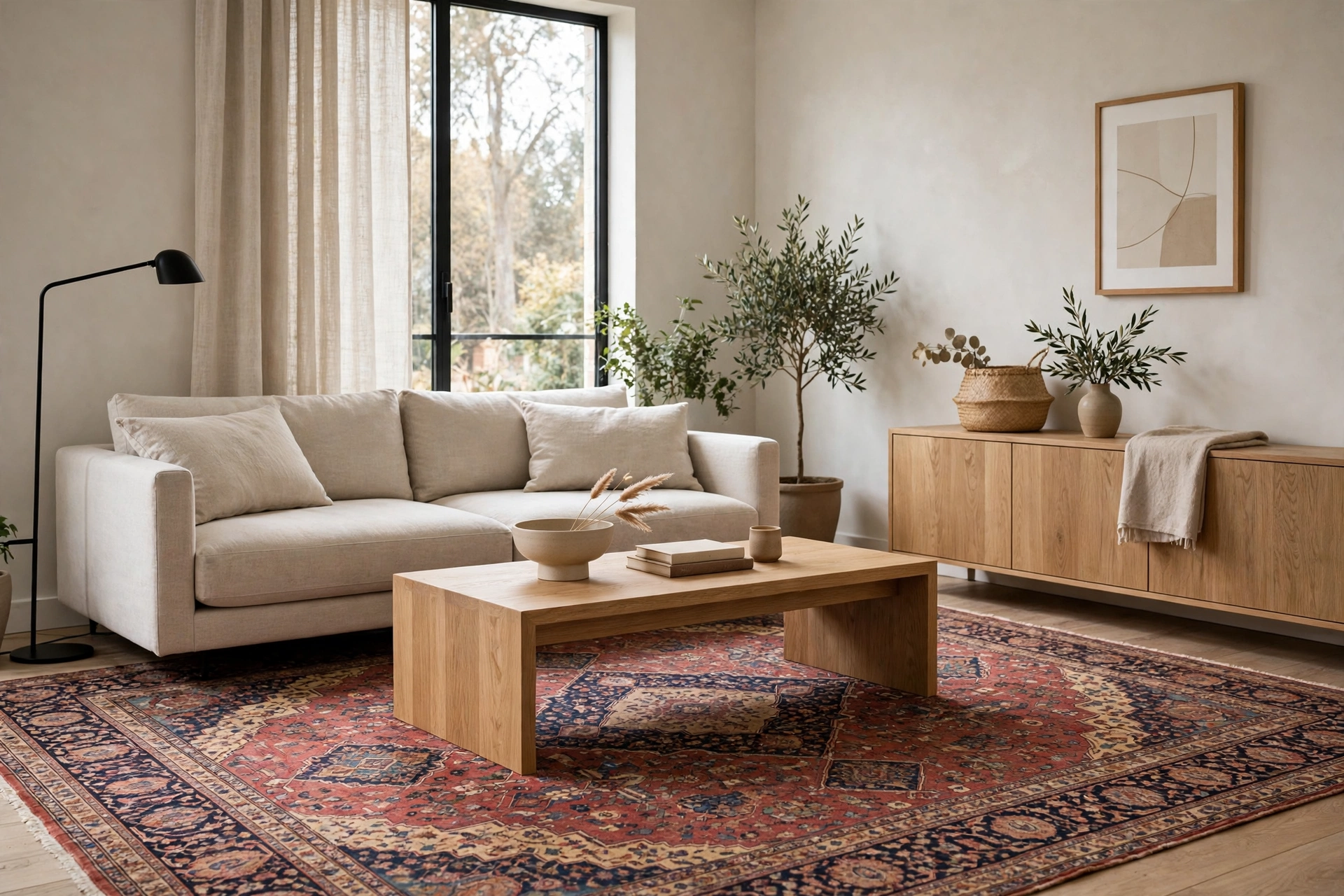
The dated Persian room almost always has the same furniture problem: the rug has been matched with rolled arms, carved wood, skirted upholstery and dark formal pieces, until the whole room belongs to one era — and it is not this one. The fix is not to replace the rug; it is to give it modern company. A low, simple sofa, plain-legged chairs, an unadorned coffee table: clean lines are the frame that makes the rug’s ornament look like art instead of upholstery.
You do not need a fully modern room. One or two clearly contemporary pieces — the sofa, or the lighting — are enough to relocate the whole arrangement in the present. Keep at least some furniture legs visible and the layout slightly relaxed rather than symmetrical; formality is an era signal, and a little asymmetry is the cheapest moderniser there is.
Tip: If your existing furniture is traditional, start with the coffee table. Swapping one carved or glass-and-brass table for a plain oak or matte black one changes how the entire rug registers.
Step 3: Echo the Rug’s Secondary Colours — Never Match Its Main One
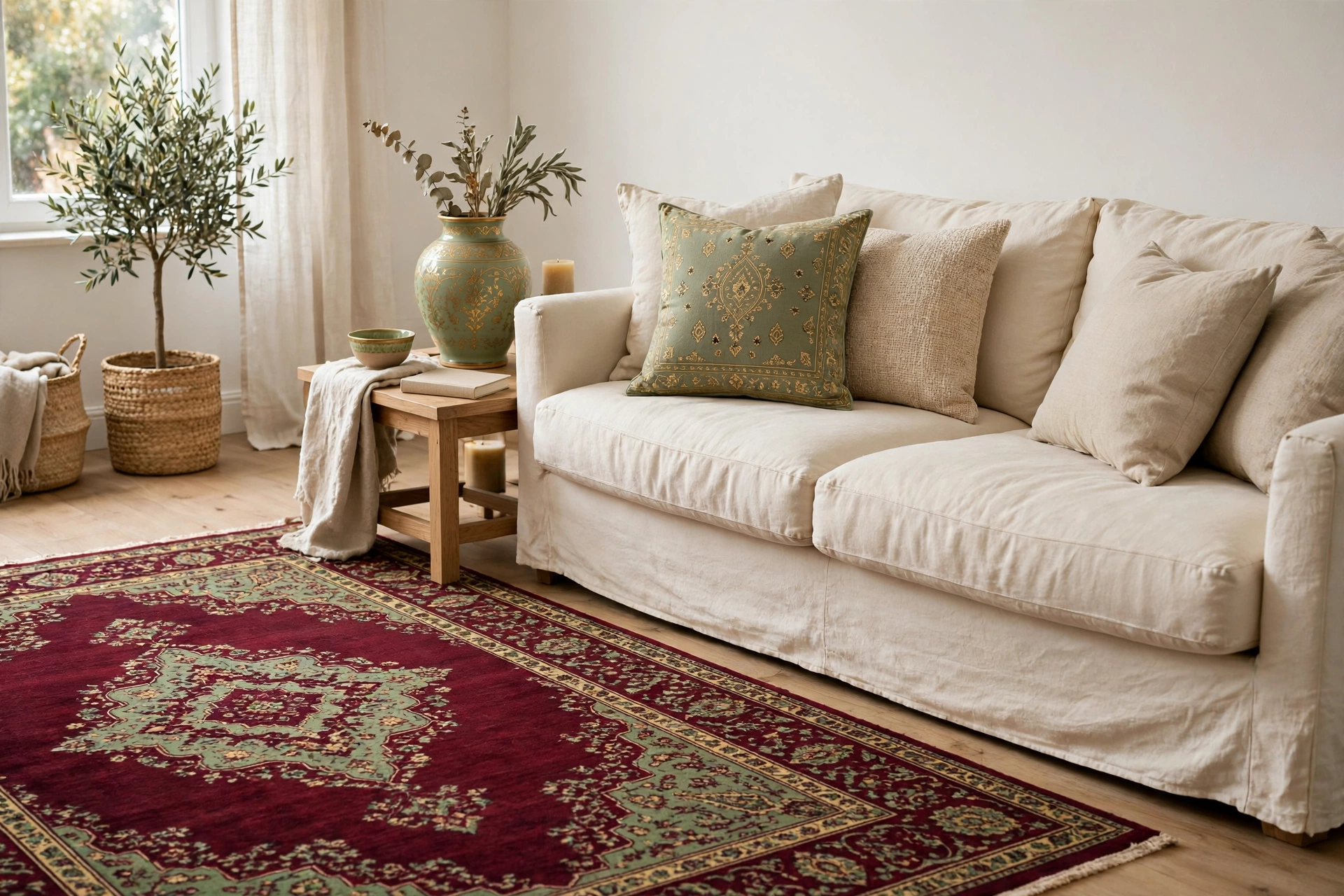
Here is the most common Persian styling mistake in existence: buying cushions, curtains or a sofa in the rug’s dominant colour. A burgundy rug plus burgundy cushions plus a burgundy throw does not create harmony — it creates a theme, and themes are what date a room. The rug saturates its colour field completely; repeating it at full strength doubles the dose the room was designed for.
Instead, decorate from the rug’s quiet colours. Every Persian holds a supporting cast — an ivory motif, a sage leaf, a thread of gold, a faded blue in the border. Pull one or two of those, at their own soft volume, into a cushion, a curtain or a piece of art. The room then feels connected to the rug without copying it, which is exactly how professionally styled Persian rooms achieve their ease.
Tip: Photograph your rug and zoom into a corner. The colours you barely noticed — that is your shopping list. If an accent colour is visible from across the room in the rug itself, it is a main colour; leave it alone.
Step 4: Make the Rug the Only Pattern in the Room
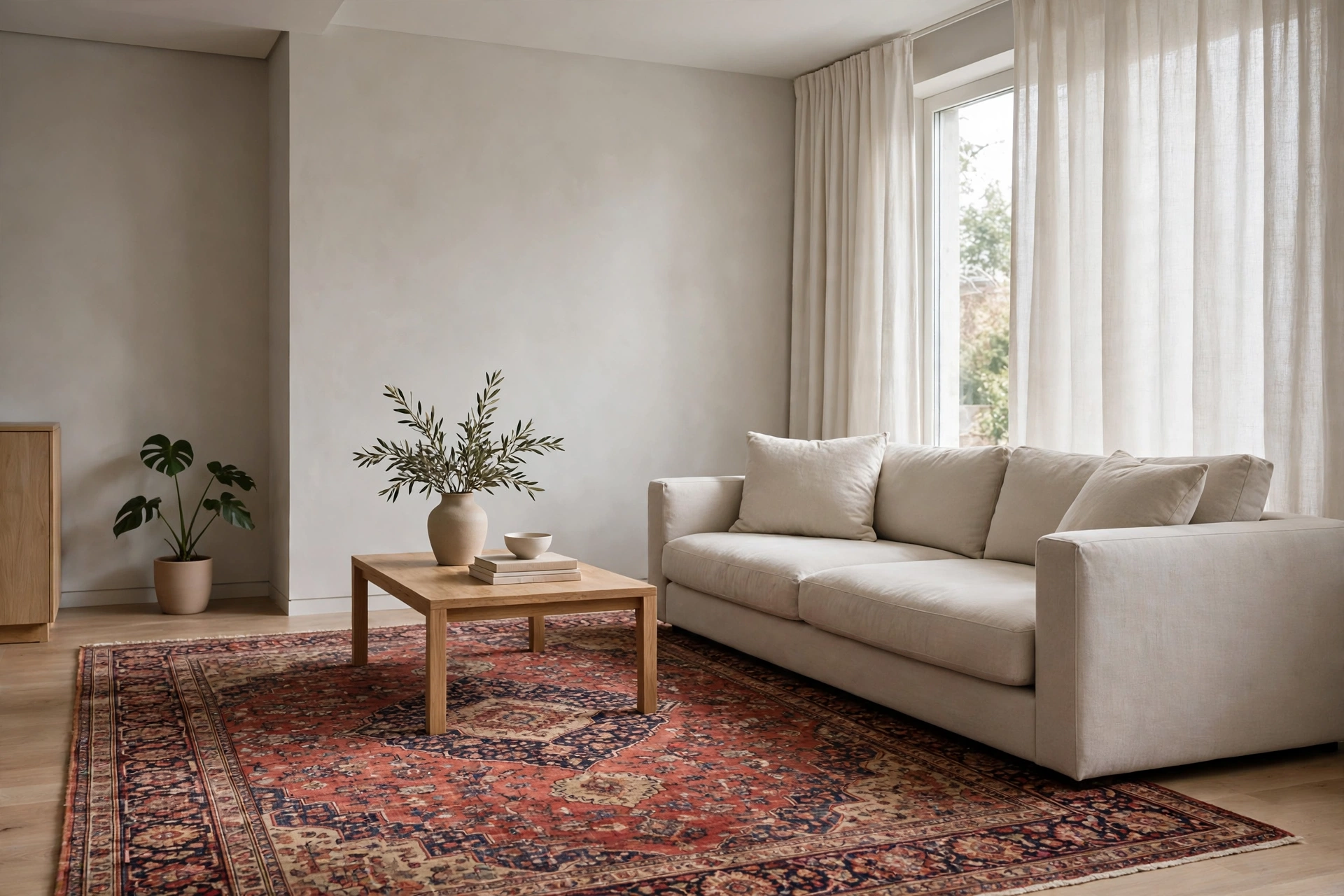
Dated rooms layer pattern on pattern: a Persian rug under a floral sofa beside striped cushions behind patterned curtains, each from a different decade, all competing. The modern rule is simpler and stricter — the rug is the pattern. Everything else in the room wears solid colour, and texture does the work that extra prints used to do: linen weave, boucle, leather grain, ribbed wool throws.
This is not a loss; it is what gives the rug its power. A Persian pattern surrounded by solids reads as a deliberate artwork on the floor, and the eye finally has the quiet it needs to appreciate the detail you paid for. If you genuinely love a second pattern, keep it tiny, tonal and in the rug’s own palette — a fine stripe in a cushion — and let it be the exception that proves the discipline.
Tip: Do a phone-photo test. Photograph the room from the doorway; if your eye cannot settle anywhere, count the patterns in the frame. Above one, remove the weakest until the rug is the only voice left.
Step 5: Size It Generously and Place It Like a Modern Rug
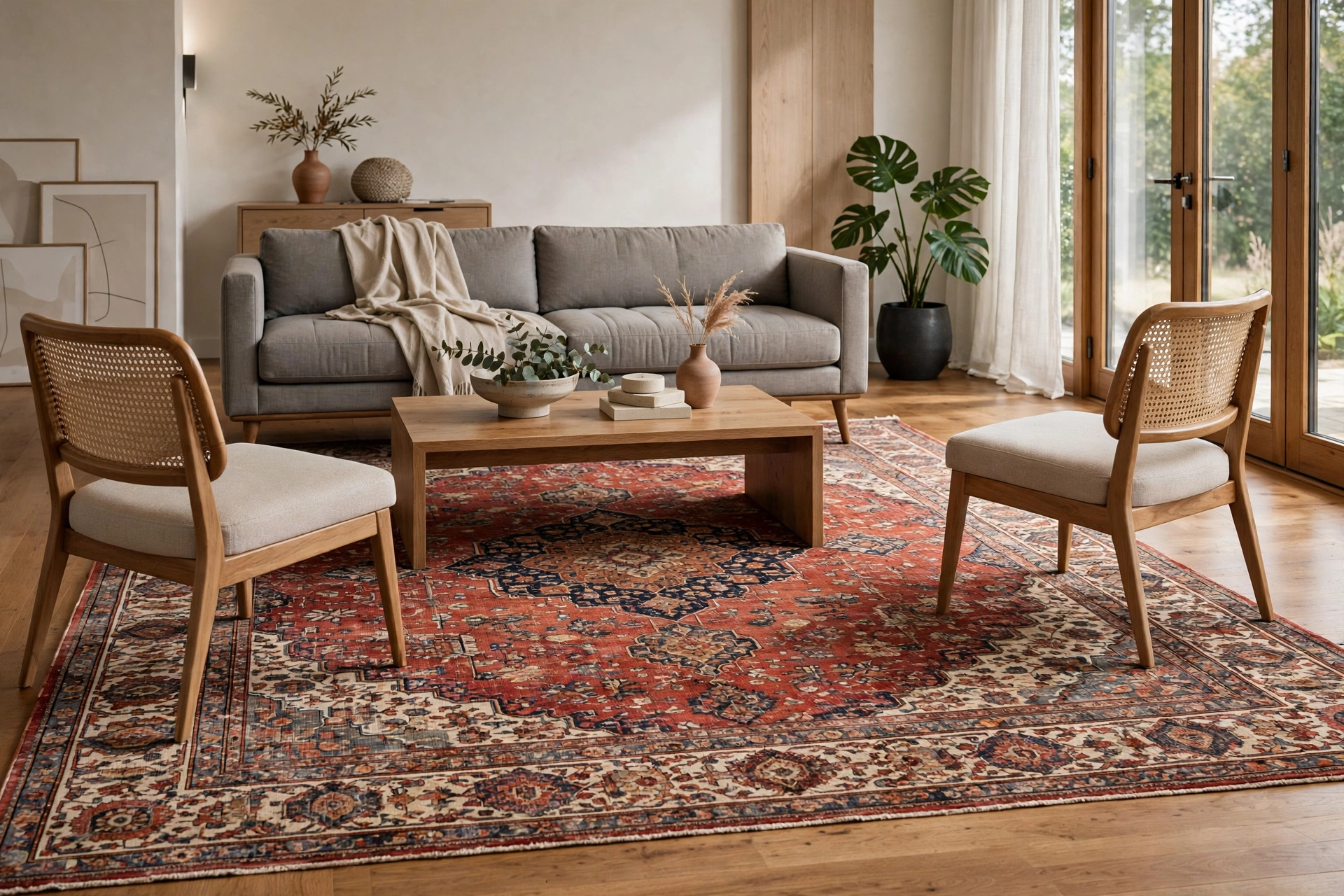
Placement is a silent era signal. The old-fashioned layout — a modest Persian floating in the centre of the room, all furniture standing on bare floor around it like visitors — instantly ages a space, because it treats the rug as a display object. The modern layout is the opposite: the rug goes under the furniture. Front legs of the sofa and chairs on the rug at minimum, all legs on in larger rooms, so the rug functions as the foundation of the seating group.
Generous sizing does half the modernising work on its own, which is why a too-small Persian so often gets blamed for looking dated. If your rug is smaller than your seating group needs, layer it over a large, plain natural-fibre base rug to gain the footprint while keeping the Persian as the visible centre — the layered look is itself a current styling move, not a compromise.
Tip: Centre a medallion rug on the seating group, not the room. In open or off-centre layouts the medallion should sit under the coffee table with the border framing the furniture — symmetry with the arrangement matters more than symmetry with the walls.
Step 6: Add Modern Lighting and Art Above It
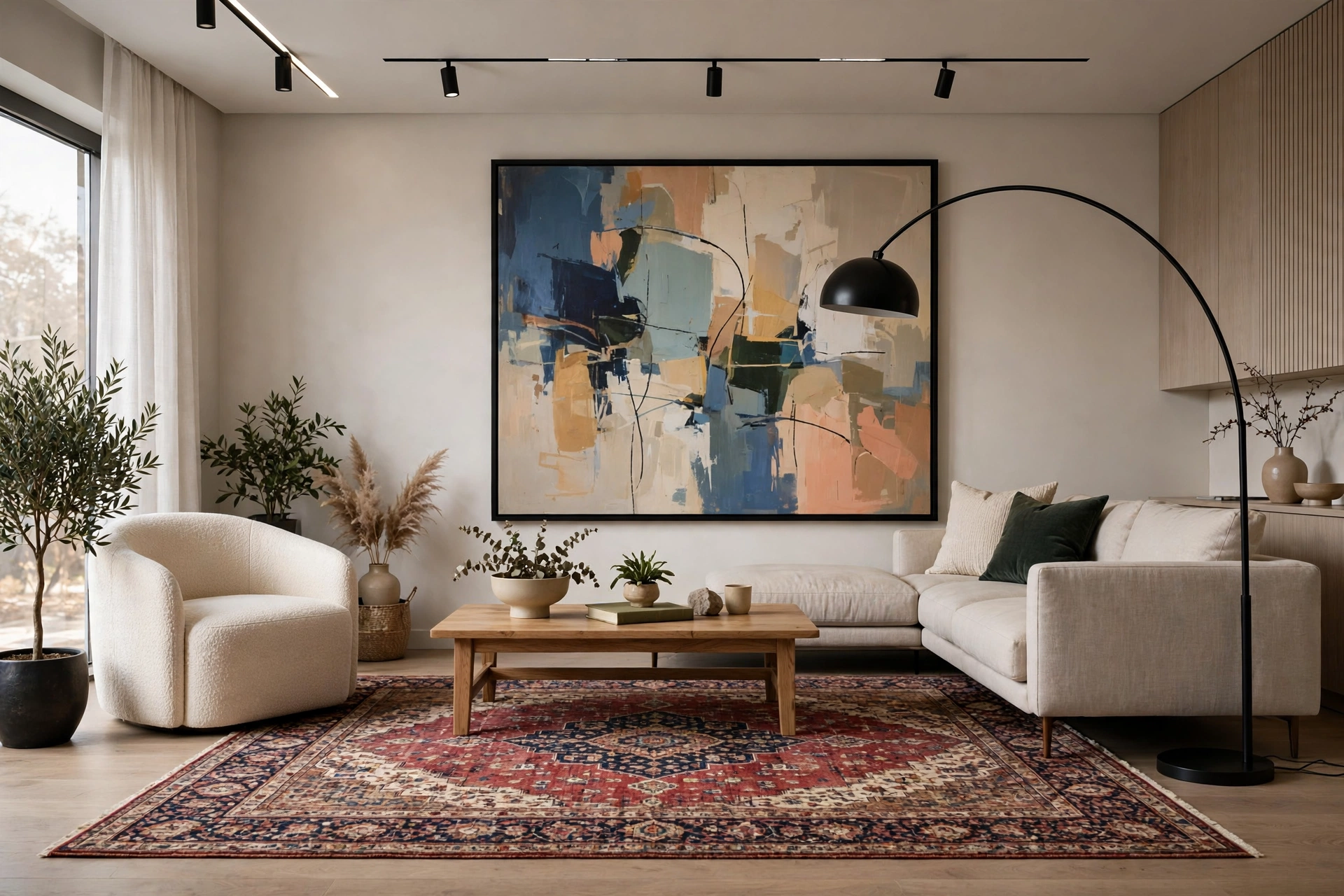
What hangs above a Persian rug steers how it is read. Brass picture lights, gilt frames and landscapes in heavy gold push the rug’s classic pattern toward the antique shop. A sculptural arc lamp, a matte black pendant, a large piece of abstract or contemporary art — these tell the eye that the room, and therefore the rug within it, belongs to now. Vertical contrast matters as much as the furniture: the rug is the room’s history, the lighting and art are its present tense.
This step is also the fastest rescue for a room that already has a Persian and traditional bones. Changing a ceiling fixture and one piece of art is a weekend project, and it reframes everything beneath it. Keep metals mixed but modern — matte black, brushed nickel, a little aged brass at most — and let one oversized modern piece outweigh several small traditional ones.
Tip: Scale the art to the rug. A big Persian under a cluster of small frames looks unresolved; one large canvas, roughly the width of the sofa, holds its own against the pattern below.
Step 7: Surround It With Modern Textures and Living Things
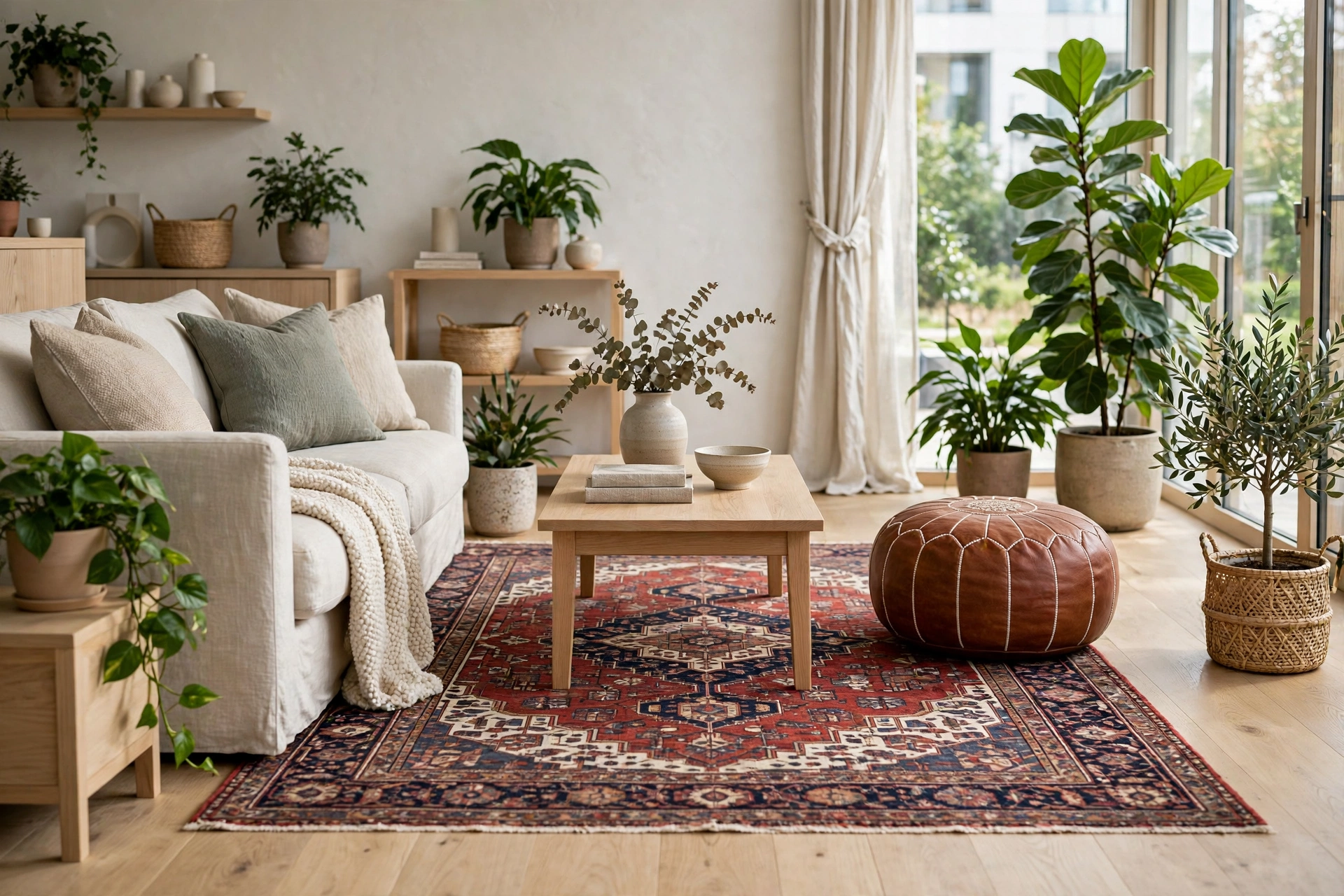
Texture is where a room declares its decade. Beside a Persian rug, the dated textures are the shiny and the formal: satin cushions, polished mahogany, silk drapes, tassels and fringe on everything including, sometimes, the rug. The current textures are matte and tactile — washed linen, raw cotton, boucle, worn leather, light oak, stoneware, and the unmistakable modern note of green, living plants. Surround the rug with those and its age reads as heritage rather than dust.
Plants deserve a special mention, because nothing else modernises a classic rug as cheaply. A tall olive or fig in the corner, something trailing on a shelf — the organic shapes break the rug’s formality, the green almost always exists somewhere in its palette, and a room with living things in it simply cannot look like a museum. Keep planters simple and modern so the contrast holds.
Tip: Retire the tassels. If your Persian has long decorative fringes, keep them combed, short-trimmed or tucked — shaggy fringe is one of the strongest subconscious “dated” signals a rug can send.
Step 8: Refuse the Theme — No Matching Traditional Accessories
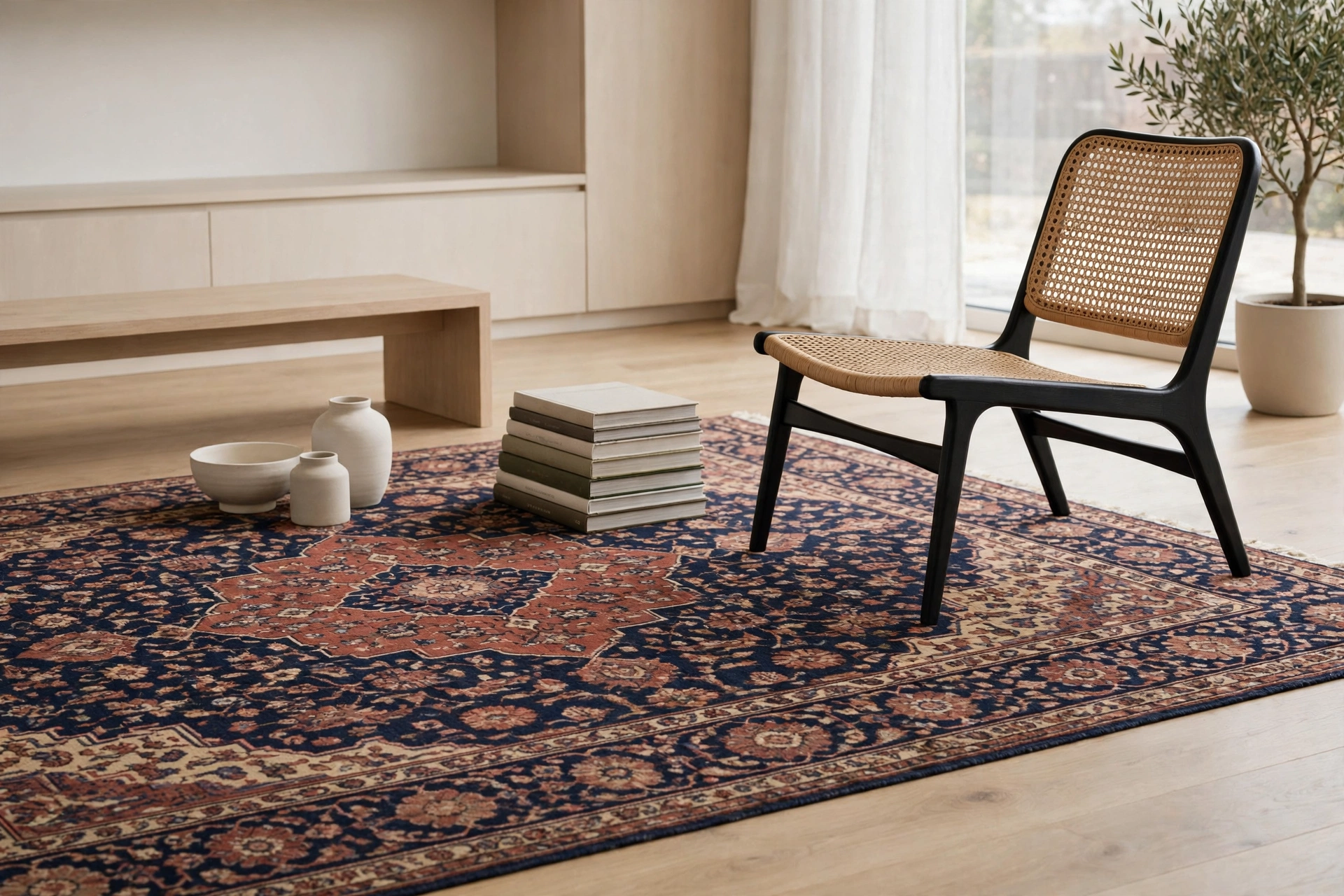
The final step is a refusal. When a Persian rug arrives, the temptation follows: hookah-adjacent ornaments, brass trays, lanterns, carved boxes, “matching” traditional everything — the room dressed as a set. Resist all of it. A Persian rug styled with themed accessories stops being a design element and becomes a costume, and costume is the fastest route to dated there is. The rug is a floor covering with a magnificent pattern; treat it exactly like any other beautiful rug and it will behave like one.
What belongs around it instead is your actual modern life, well chosen: plain ceramics, a stack of current books, one contemporary chair, the objects you genuinely use. Collected, personal and present-day beats coordinated every time. If an accessory would look at home in a period drama, it does not belong in the room — whatever its individual charms.
Tip: Apply the doorway test once more. If a stranger could name a country or a century from your doorway, the theme has crept in. Remove the most literal piece first; one removal is usually enough.
Before You Buy or Restyle: 5 Rules That Save Regret
- Spend on the rug, save on the rescue. If a room feels dated, the rug is almost never the problem. A modern coffee table, one lamp and solid cushion covers cost a fraction of a new rug and fix the register of the whole room. Audit the surroundings before blaming the floor.
- Fringe, pad and edges matter more than you think. A curled edge, a bunching corner or a shaggy fringe makes even a beautiful rug look neglected. A proper felt pad, flat edges and tidy fringe read as “curated” at a glance.
- Never buy the matching set. Rug, cushions and curtains sold or chosen as a coordinated traditional set is the dated look in its purest form. Buy the rug alone, then build the room from its secondary colours with modern pieces.
- One era per category. The rug owns “old”. Furniture, lighting and art should each have at least one unmistakably current representative. Before buying anything traditional to “go with” the rug, check whether the room already has its quota of age — it does, and it is on the floor.
- Live with each change for a week. Styling shifts need settling time. Rearrange placement first (free), then textiles, then furniture. Rooms restyled in stages almost always land better than rooms redone in a single dramatic weekend.
Frequently Asked Questions
Why does my Persian rug make my room look old?
Almost never because of the rug. The usual causes are a too-small rug floating away from the furniture, cushions matched to the rug’s main colour, traditional furniture and accessories completing a theme, or a bright, high-contrast rug with no faded softness. Fix placement and surroundings first — the rug usually stays.
What furniture goes with a Persian rug in a modern home?
Clean-lined, low-profile pieces in solid colours: a simple linen or leather sofa, plain oak or matte black tables, contemporary chairs. Let the furniture’s shapes be modern and its colours quiet, and echo one of the rug’s secondary tones in a single accent.
Should a Persian rug’s fringe show?
Short, neat fringe is fine and authentic. Long, tangled or yellowed fringe is a strong dated signal — comb it straight, consider having it professionally trimmed or bound, and never let it disappear under furniture where it bunches.
Can I use a Persian rug in a minimalist room?
Yes — it is often the best room for one. A single faded or overdyed Persian in an otherwise empty, calm space becomes the room’s entire story: pattern, colour and warmth in one piece, with nothing competing. Keep the palette strict and the rug generously sized.
The Bottom Line
A Persian rug dates a home only when the whole room agrees to travel back in time with it. Keep the rug as the room’s one piece of history — faded rather than bright, sized and placed like a modern foundation, echoed instead of matched, and surrounded by clean lines, living textures and contemporary light — and it stops being a period piece and becomes what it has always been at its best: the most beautiful, confident and current thing on the floor.
Save this guide for your next room refresh, and follow Decor Velora for 3 fresh home decor ideas every day — rugs, small apartment decor, mirrors, curtains and cozy room makeovers.